Monday, October 5, 2009

Don’t worry about telling us what you think about the Lisbon treaty Dave, just promise us the chance to have our say!

Ah, politics and politicians. There has been a lot of talk since the expenses crises about how our elected servants need to stop taking the public for granted and actually start listening to them for once. Now I don't advocate, like some people, that the populace should be allowed to vote on every single piece of legislation or decision taken in some sort of bizarre mix of Prime Minister's Questions and the X-factor. I don't even think that we should have a direct say on the vast majority of decisions taken by our government. After all, the whole point of having elections in a representative democracy is to appoint or turf out those who do. What I have always believed is that democracy is best served when political choices are taken at the lowest practical level because in such cases it is easier for the general population, if they are so inclined, to influence the decisions taken in their names. This becomes increasingly difficult with decisions that can only be taken at a national level, such as those involving defence or foreign affairs, but (and admittedly it's a big one) as long as we have effective representatives holding the government to account then there should be sufficient oversight.

There are though some proposals that have such large implications for our constitution and thus the way in which we run our supposedly democratic country, that in my opinion it would be morally unjustifiable to deny citizens the right to accept or reject them. There is no doubt, except in the strange parallel universe in which our present government seems to reside, that the Lisbon Treaty is such a document. Other figures in Europe have no qualms about admitting this, as did the former French president, Valarie Giscard d'Estaing, who said that the Lisbon treaty and his still-born European constitution were for all intents and purposes the same thing. French voters are cynical (or perhaps supine) enough to accept that their politicians are sufficiently slippery to have used a rebranding of the constitution they rejected in a plebiscite as a treaty thus removing the need for a further referendum. This contrasts with the inept shower that purports to be the UK's government, who try to have us believe the treaty is nowhere near as significant. At a time when politician's stock is at (what I sincerely hope) will prove to be its nadir, such blatant lying should be challenged in the strongest of manners.

Step forward David Cameron. As I write the media is currently salivating at the prospect of the Conservative party potentially pressing the self-destruct button labelled Europe at its forthcoming conference in Manchester. It has been said that the Tory leader must walk a tight-rope between the Eurosceptics in his party and the minority that wishes to continue with European integration. It has been said that the government will use this issue in an attempt to distract the media and public from what the Tories have to say about their wider policies, attempting by claiming that they are the same old divided party as they were in the 1990s. I must confess to being partial in that I, as somebody who is going to vote conservative this time around, am worried that the Tories will descend into a debate about this subject that will be reported as infighting by the media. I hope that David Cameron will be deft enough to manage this situation, but frankly I think he has boxed himself into a corner when he needn't have.

Dave's first mistake was to promise a referendum on the Lisbon Treaty if, at the time of the forthcoming election, not all the countries in the EU had ratified it. This, after the Irish "amended" their ways by voting yes at the second time of asking, has now put him in a difficult position as he is not prepared to guarantee a plebiscite if the treaty is in force by the time of our election. At best this gives the impression of dithering, and at worst it may suggest to the electorate that in reality he would rather not have a referendum. Given the low esteem that politicians are held in at present, playing around with the electorate is not a wise thing to do. Labour can say what they like as they are desperate and they have nothing to lose so they will probably label the Conservatives as a thousand and one things before the election. Europe offers them an opportunity, as they know the Tories must obtain an almost unprecedented result at the next election if they are to win an absolute majority. The electorate are still unsure of the Conservatives and any potentially divisive issues could cost the party dear. Remember, if no one party wins an overall majority at the polls, this will give Gordon Brown the opportunity to cling to power by forming a coalition with the Liberals, even if Labour finishes a poor second in the polls.

So my advice to Dave is this; when you get up to give your speech to the party conference this week push the idea once again of putting real power in the hands of the people. Promote the localist agenda by saying where possible that as many decisions as possible should be made at the level of government closest to the people. It can then be argued that if we should trust the populace to have a bigger say over how their local communities are run, then they should have the right to vote in a referendum on the Lisbon Treaty, regardless of whether or not it has been ratified by the election. He should then go on to argue that in his opinion, the Lisbon Treaty would be bad based on the fact that it would concentrate even more power in an unaccountable political elite, just at the time when the people are demanding more and more transparency from their politicians. If anybody were to argue that point he could point to the sidestepping of French and Dutch referenda results, and the "vote until you get the answer right" policy in Ireland. But the key point would be to stress that the people are the boss, that it should be their choice to make, and if they were to decide to accept the treaty then as their servants, a conservative government would move on, do as it is told, and get on with the job without being so arrogant as to ask the people again if they're sure they made the right choice. Put quite simply, democracy shouldn't just be left to the X-factor.

Sunday, October 4, 2009

Acts of fraternity to conserve the liberty of a convicted criminal are nothing but a smack in the face for equality.


I love France, I really do, but goodness me there are sometimes when I think the politicians and the chattering classes really need a good talking to. France is in the thrall of the Roman Polanski extradition and it has been amazing to see not only luvies, but also politicians here (including the Foreign Minister, and to a certain extent President Sarkozy) say that the fact that a paedophile, who has been on the run for more than 30 years, has eventually been caught is a bad thing! Please don't get me wrong, I think the man is very talented, and yes of course this is somebody who has known real tragedy in his life. Talent and sympathy, however, provide no justification for the denial of justice, particularly for a crime such as this, where he has, lest we forget, admitted a certain amount of culpability.


I should by now have become cynical enough where the French media and intelligentsia are concerned to realise that, despite all the noise they make about "les droits de l' homme", "la justice", "la solidarité", "la république" etc, these are in fact ideals to be aspired to by us little people, the ordinary citizens comprising around 99.99% of the population, as espoused by our cultural and intellectual superiors inhabiting the increasingly incestuous spheres of academia, the media and politics that make up a large proportion of what is effectively the ruling elite of France . This great caste of cultural shepherds, the aristocracy of the 5th republic, never tire of telling the French what they should be thinking and how they should behave. But woe betide anybody that contradicts their humanistic gospels as certain writers and thinkers have discovered, for the caste will at best make every interview you ever give a cross-examination; a trial not only of one's work and opinions, but of one's very soul. At worst such people will be forgotten about or actively ridiculed.


Behaviour like this is bad enough, but it would be just about digestible if the members of the caste were the fine examples of virtue they undoubtedly would be if they ever followed their own advice. The problem is of course, as a group, they never have and they never will, and it is this arrogance that can be found in any decrepit debauched ruling class. The case of Roman Polanski is a fine example: where might I ask is the social justice in not letting a convicted sex offender be accountable for the crimes he has been convicted of committing; why for example in a news report lasting for five minutes on French TV's main new broadcast yesterday, did a woman representing a society for abused children talk for less than 30 seconds?


One line that has been rolled out by the French establishment, including the culture secretary Fréderic Mitterrand, is that the crime took place so long ago that Polanski should effectively be pardoned. This ridiculous notion is actually considered to be fair by many in the French establishment. Poor Ronnie Biggs, if only the Great Train Robbery had taken place in France he could have come back from Brazil ages ago with complete impunity! Apparently, selective amnesia is the "just" thing to have in cases like this, and it is the backwards Anglo-Saxons, this time in the form of les américains, who have the temerity to continue chasing the director when it should all be brushed under the carpet (although criticism of Anglo-Saxon legal systems is a little rich when it comes from the direction of a country that has only recently adopted the idea that one is innocent before being proved guilty).


"But there is surely more to it than that" you may ask, and you'd be right. Some French commentators have actually come out and said that such impunity is justified as Polanski is a great artist. But now have we reached the point where artistic talent trumps justice? And in any case I hear you ask, "Who is to decide what is art and if it is good or bad?" In the case of the French intelligentsia the answers are so obvious that they are self evident. A publicly pronounced decree of what is good or bad art by a senior member of the caste is quite naturally the right opinion as no sane person would have tastes or opinions to the contrary. But this argument could be extended further to any form of human endeavour. Not everybody puts art up on a pedestal and the importance of a profession is often relative to the regard in which it is held by the person making the assessment.


This reasoning alone would be absurd enough; i.e. to guarantee Polanski's liberté by denying the principle of égalité for all
before justice thanks to an absurdly misplaced sense of fraternité with a tortured and creative spirit. Unfortunately I believe the real reason is far more odious and is an example of an abuse of trust that all ruling classes in all types of society far too often perpetrate. Even if it is only in the subconscious of the French intelligentsia and politicians, rather than actively occupying their thoughts, the patronising notion that the little people are of a lesser stock, and it is they who must obey the rules and the noble principles on which the republic was founded on, runs rife in the heads of the French aristocracy. Sadly, in France it would appear justice is partial to the tastes and passing fads of the elites. I must have missed that noble concept when recently reading up on the principles of the revolution!

Monday, April 7, 2008

Bling and balls, style and substance

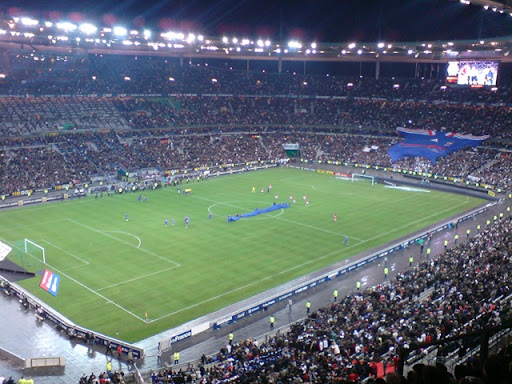
DSC00011

It was the night of Wednesday the 26th of March; I found myself high up in the stands of the Stade de France cheering on the visiting England football team against a somewhat under strength French squad. Although the cold of that evening at times was rather piercing, the same, unfortunately could not have been said of the attacking prowess of my team as they contrived to lose 1-0 to thanks to a first half penalty. This game represented the only chance that I’d get to see my national side this year; I had hoped, thanks to the ease of commuting from Paris, that I’d get to the follow “the lads” for the first time in the midst of the forthcoming European Championships in Switzerland and Austria. But alas, fate, in the form of Croatia and Russia deprived me of my football inspired holiday in the mountains. So England supporters, just like those of the three other teams from the UK, along with the Republic of Ireland, will have to adopt a nation this summer.

If ever a team has been over hyped then it is this current England side that was christened, quite laughably with hindsight, the “Golden Generation”. For the past six years they themselves, along with some sections of the media whipped up expectations by declaring that they were the strongest group of players we have ever had and that they would end our 40 plus-year-long wait for a major international title. So two World Cups and a European Championship came and went, and what did we get? Defeat in three quarter finals…not bad but not the stuff of world beaters. And then last autumn, abject failure. They were finally shown up for what many in England now believe they are, a group of flashy individuals rather than a team, a collection of highly paid chokers, more worried about their mansions, sports cars and pop star wives and girlfriends than the honour of representing their country; a generation not so much golden but rather one of bling. 

Meanwhile, whilst I was catching a cold at the Stade de France, President Sarkozy of France was in the UK as guest of honour at a  banquet thrown by the Queen during the first evening of his state visit to Britain. The timing of the football match between France and the UK’s biggest constituent nation was quite apt as many of the same criticisms that the English aim at their football stars have been thrown at Sarko by the French. All of the initial promises that the President made just prior to, and after his election, of rupture and reform to galvanize France have yet, in the eyes of many, to come to fruition (however to be fair Sarko has only been at the helm for ten months whilst the England football team has been constantly predicting false dawns for around the last six years!). Added to that there is the “bling factor”, his taste for Rolexes, the highly publicised divorce, and the general sense that he has played the media game far too much, and as a consequence many French believed that this reflects badly on the institution of the presidency itself. And if that wasn’t enough, the final whirl-wind romance with and marriage to the Italian former model-turned singer, Carla Bruni did nothing to counter this perception. On the face of it, Sarko’s life was beginning to resemble at best that of an English footballer’s and at worse a storyline from a bad soap.

Sarko has been punished recently, not only in his poll ratings but also in the local elections, so with this in mind it is clear that  his advisers have been keen to cast him in a more dignified and more “presidential” role, and in many ways the trip to the UK in March could not have come at a better time for him. The royal pomp and circumstance that accompanies a state visit to the UK provides the perfect environment for those who wish to appear more “stately”, providing of course that they make no serious gaffes. But this was unlikely; the Queen has been doing this for more almost 56 years, and everything is planned to the finest of details.  Thankfully for Sarkozy, it would appear that both he and his hosts were up to the task. He was courteous, didn’t really put a foot wrong and charmed his hosts with praise with talk of the UK as the mother of parliamentary democracy, how France would never forget the sacrifices the British made in the War, how the French should look to the British commercial model, and also how Britain should not be reticent about playing a central role in the development of Europe. Although both the French and the British may not have agreed with all the content of his message (probably for different reasons) it was clear that its sentiment was well-received in the UK, and the French, well, they were just happy to have a president again! His approval rating of around 40% just after the visit may not have been remarkable, but in the context of the dire polls at the beginning of the year, they were certainly not going to be sniffed at in the corridors of the Elysée Palace.

However there was only one star of the show, particularly where the British were concerned, and that was Carla. The British press,  Gawd bless ‘em, had decided to put a picture of the new first lady in her birthday suit (which was going to be going under the hammer in New York) in prominent positions in their papers. This certainly got people’s attention, but it was clear that from the moment she stepped off the plane with the President (dressed in a fashion evoking memories of a certain Jackie Kennedy) who the star of the show was likely to be, and so it proved to be the case. She was the talk of the UK with journalists and MPs alike swooning over her. Certainly Prince Philip seemed to enjoy her company! The French seemed pretty impressed too, mind you we’ll see if her stock remains so high over here when her latest album is released. But, in the mean time a bit of British pomp aligned with some Italian style seems to have stopped some of the rot. I, as an England football fan, can only hope that my country’s new Italian coach, Fabio Capello, can have a similar effect on my nation’s players. 

Tuesday, March 18, 2008

Drinking, love, the nightclub, and growing up

17127_clubbing

Growing up is a stealthy process. True, when one is in their teens it’s quite marked, but as my 30th birthday looms ever larger on the horizon, I sometimes struggle to think of major differences in my personality, from say when I was 22. Of course, there are some which spring instantly to mind, such as my inability to eat too much without getting fat, something that the 22 year-old-me was rather good at, but fundamentally, despite many things that have changed in my life, and the many experiences I have been subjected to, I feel pretty much the same. My attitudes, and my opinions (and some would say prejudices) have, at most, been subject to a partial evolution but I still hold the vast majority of views that I held 7-8 years ago, despite the extra life experience I have accrued in the intervening years. But am I the same? Well I’m not so sure anymore, and the reason for this latest revision in my thinking comes not from exposure to some profound argument or life-changing experience, but rather from a somewhat innocuous source…a night out to celebrate my brother’s 25th birthday.

229657_clubbing_2

Ah a birthday! Was it the thought of my little brother turning 25 that had plunged me into this analysis you may ask? As reasonable a conclusion as that may seem to be, it was not the catalyst for this reassessment. No, instead it was reliving a pastime that a few years ago would have been often the focus of a typical Friday or Saturday night out. Back then, in my late teens and early twenties, the world, or rather my world was a very different place. Life consisted of being at uni and when I wasn’t there during the holidays I was earning money to carry on studying and meeting up with school friends, and all three of these activities led to the obligatory nights out on the town. Regardless of the people you went with, the format was usually pretty similar; go out to a pub/bar, if possible a cocktail bar in order to get “primed” (or sometimes at uni this would consist of a cheap bottle of plonk per person in somebody’s room or house if money was tight), before maybe going to another bar, then finally followed by a nightclub. Sometimes there would be only two of us, other times it would be en masse with the groups consisting of mate774291_bar_1s who were both boys and girls.

Two common expressions used to couch the aims of these evenings would be to “go on the pull” or “get pissed” and in many cases try and combine the two, just as long as you didn’t pull a “minger”, although as everybody knows the combination of these aims often leads to the result that we were determined to avoid. That was the simplistic gloss that we put on the whole exercise, but in my case, and in those of others whom I know, this was certainly a smokescreen, as the true aim was often to finally engineer a defining event with a girl you were close to in your peer group, that would take what would often be an ambiguous friendship and to precipitate a sea-change in its nature, where all the games would stop and the cards be placed firmly on the table. In my case at least, that never happened, sometimes due to circumstances, but mostly due to social cowardice, so I always reverted to the default setting, back to the thrill of chasing the stranger. Don’t get me wrong the default setting was fun, and on the very few times I did “get lucky” at best I had fun and at worse I had learnt a lesson and provided my mates with a bit of banter.6a00d83451c83e69e200e54faae8768834-800pi

Although there are probably countless counter-examples, I firmly believe that the club is no place to meet someone who is a cut above the rest. Quite frankly one leaves too much to chance. For starters it’s difficult to have a decent conversation with anybody and in some places, thanks to the lighting (aided of course by the alcohol), you might not even be able to see whom you’re talking to properly! I am therefore not surprised that I met every girl that I have ever had feelings for that were more profound that just “she’s hot” in far more normal and sober surroundings. The ultimate example being my current partner, whom I met in the common room of my college in the week that I started my Ph.D, whilst I was reading the paper. From that point on the dynamics of the night out changed; the pressure to pull evaporated.

But the nightclub without the thrill of the chase is a changed beast. It is still fun if you are with people whom you know and like, but when the overriding sexual element is redundant, and the company you are keeping is not the best they can be the most boring places on earth. I realised this a while back, but as I said if I was out with good friends it didn’t matter as the company would be fun and we’d all have a laugh and get drunk together, ending in a kebab and a funny anecdote; i.e. a perfect night out. The jolly with my brother ticked all of those boxes, and although I did enjoy myself, I was struck by the fact that this is no longer the model for the best time out with my mates. Last week back in the UK was hectic, as I managed to meet many old friends, but in almost all cases it was in the context of a quiet drink or meal and good conversation. Maybe it is the French influence that my partner has imparted upon me (after all I saw many blokes older than I at the weekend completely larruped as they attempted to pull girls in short skirts and corsets that were sometimes young enough to be their daughters), or perhaps it is just the fact that the advancing years, in my case, has led me to prefer good wine and food combined with intelligent discourse to gyrating in a drunken stupor on a dance floor.

Tuesday, March 11, 2008

Paris to London and the TGV

800px-Eurostar_at_St_Pancras_railway_station

I have always enjoyed travelling by train; whether it takes a couple of minutes between little towns in Oxfordshire, or an overnight journey along the east coast of America, it never seems a chore. One of the things I love about France is the TGV (Train a Grande Vitesse) network. For a Brit it truly is remarkable to be able to travel on land from Paris to Avignon in around three hours, especially when one considers the time (and cost) it takes to make a comparable voyage in the UK such as London to Edinburgh.  The TGV, in the guise of the Eurostar, has always been my preferred method of well not hopping across, but rather burrowing under the channel. Napoleon once said that, despite his failure to cross it, the Channel was “merely a ditch” and that somebody would easily be able to traverse it when they took the task on with enough seriousness. Napoleon’s words may well be scoffed at now by my fellow countrymen considering how this meager stretch of water has played a significant role in keeping out unwanted occupiers on a number of occasions, but as one travels under the seabed from France to England, one can’t help but think that the Emperor was right.

Now that the train can stretch its legs in England, Kent whizzes by in a blur, gliding and whistling past the cars on the motorway, along with the Eurolines buses that travel back and forth between Paris and London. Passing the bus now gives me an acute sense of satisfaction, as I think back to the many times I took that 10 hour coach journey last year, and the interminable boredom it represented. Yet as we blasted through the garden of England, I couldn’t help but feel for those who were on it, faced as they were with another two hours at least before arriving at their destination. So two hours and fifteen minutes after pulling out from under the shadow of Montmartre we arrived in London, but despite the 30 minutes gained I do miss the spectacle of travelling slowly along the Thames towards Waterloo. Leading up to, and just after the time that St Pancras International opened, Eurostar pitched the new link to the French as the chance to travel, for the first time, straight to the centre of Britain’s capital (they also suggested that it was now even better as they’d no longer have to be reminded about the battle of Waterloo, but I have no sympathy for them there, as they themselves named a train station in Paris after Napoleon’s victory at Austerlitz).  The new journey is fantastic, but no more so in some ways than when the train pulled into Waterloo. Of course the trip is shorter by half an hour, but curiously Eurostar, in their recent advertising push, have tried to convince the French that St Pancras is closer to central London than its predecessor. Yes it may be easier to catch connecting trains to other parts of the UK, but I am not convinced it is placed more centrally than Waterloo. On the approach to the old station, one was treated to the majesty of the Thames and the Palace of Westminster, now when it arrives one simply pops out of a tunnel into the station, but maybe that is not such a bad thing considering what the Kings Cross area is famous for!St Pancras 01

That said, what a station! I have been told by more than one French person that one of the things that the British do have is the ability to blend the old with the new, a country that has given the world cutting edge art, music and architecture, yet at the same time guards many of its traditions. St Pancras can be viewed as a physical expression of this contradiction that the French find so beguiling. It has been called by the President of the French railway network (SNCF) the greatest station in the world. High praise indeed.  One cannot fail to be impressed at how effortlessly the metal and glass has been fused with the grandiose red brick gothic edifice that acts as the structure’s facade. It was the poet Sir John Betjeman that managed to prevent the building’s stunning structure from being smashed during the period when it was in vogue to demolish what was regarded then as over the top Victoriana. So it was saved, but stayed there for decades, slowly decaying. One wonders what Sir John would think now if he could peer through the glass ceiling with its sky blue framework, towards the station's gothic tower. All the UK needs now, like the French have, is the complete train network to match the architecture.

Saturday, March 1, 2008

But if The French think that's bad, well over to you Prezza!

The French may be in a tizz over Sarko's recent antics, but if you're going to deal with a heckling farmer, well do it properly, as when good old Prezza brought yet more distinction to the post of Deputy Prime Minister when he punched somebody that threw an egg at him during the 2001 UK general election campaign.

I also include this link from Have I Got News for You at the time. Paul Merton and Ian Hislop offer their thoughts on the Deputy PM's bout.....pure class!

"Casse-toi pauvre con !" - Why Sarko can't be a jet setting agitator for change and be President of all the French

Nicolas “Speedy” Sarkozy, or “Sarko” as they tend to call him here has had, to put it mildly, an interesting first nine months since being elected President of the Fifth French Republic. The President of France is an interesting job. It is meant to be, as head of state, a unifying figure for all the French; in fact Sarko made great play of this point as being central to his conception of the role in last year’s election campaign. To this end the post is stepped in grandeur, the Elysée Palace is a building of pure majesty with its golden pillars, tapestries and jade sculptured ceilings, whilst the President’s attendants are immaculately dressed in white ties and tails. Then of course there is the Republican Guard who really are the French version of the UK’s Household Cavalry, and to top it all is his official dress at state occasions, get up which make the average king hang his head in shame for fear of being underdressed.

This post has a grandeur associated with it which makes the US President, living in his little White “House”, look a little, well how should I put it, bland by comparison. But I think that this offers an interesting example of how the French and Anglo-Saxon attitudes towards exercising power and national unity differ. The President of the US is not only head of the government, but also the head of state and figure of national unity, but given the partisan nature of the first part of his job and the character of American republicanism, he takes the form of most elected politicians. The UK has (as well as the other countries that continue to retain her) the Queen to exercise all of the parts of the job concerning the representation of national unity, as well as being the ultimate constitutional backstop if any government were really to take the mickey out of our freedoms and liberties (some may argue this point has come, but that’s for another entry!) whilst the much more sober, business-like and divisive position of Prime Minister actually runs the show, which is of course, as it should be.

But France has both models rolled into one. In theory, there is a distinction between the “Chef d’Etat” and the “Chef du Gouvernement”, namely the Prime Minister. Before Charles de Gaulle created the Fith Republic in the 1960s to chime with his own personal vision of a strong Presidency, the President didn’t have that much to do with running the country, rather it was the Prime Minister who dealt with that. But the fith Republic gave rise to a President that not only kept the ceremonial duties, but also took responsibility for directing the government. However, the Prime Minister was retained to “implement” the policies decided on by the head of state. This meant that, just as de Gaulle probably wanted it, the President was now the sheriff, whilst the PM became very much the faithful deputy (to put it in terms George W. Bush would understand). Or perhaps, if one is more cynical, it took its inspiration from the French absolutist monarchical model, with a few tweaks included to make sure Liberté, Egalité, Fraternité were still paid lip service to. However, what de Gaulle was unable to envisage was what has happened on a few occasions since, and that is the curious French phenomenon of cohabitation. For example, if the party that has a majority in Parliament is not that of the President, thanks to the whims of the French electorate or quirks of the voting system, then he/she has no choice but to appoint the leader of the largest party in the Assemblée Nationale as Prime Minister as his/her own would most probably face a vote of no confidence. When this happens, all the President really looks after is foreign affairs, and perhaps defence, but the power certainly shifts from the Elysée Palace to the Hôtel Matignon.


Sarko does not, at present, have these worries, so he can, and some say does, project an image of a head of state of which the arch absolutist King Louis XIV would have been proud. But despite the flack that many of the critics have subsequently given “Sarko Premier”, he appeared at first to be rather unusual in that he was more than prepared to show his human side; no other French President would have ever thought of going for a daily jog à la his US counterpart, or for that matter spoken to the public in such a frank or clear-cut manner. In addition this all took place in the context of his radical promises of reform for a stagnant country signifying a “rupture” with the past. Things were going well, despite the socialists calling him a dictator and a demagogue (I mean how terrible is that, a politician saying that he’ll do what the uneducated, ignorant plebs want!), and his opinion poll ratings were 60% plus. But the honeymoon has ended, and quite spectacularly at that.

Honeymoon is an apt description of the period as it preceded major causes of the events that have subsequently overwhelmed the President; namely marriage, or to be more accurate, marriages. The fall out from his divorce from his first wife, Cecilia, has been spread right across the media, a relatively new practice for the once highly deferential French press, as has his whirlwind marriage to the Italian former model turned singer, Carla Bruni. Okay, one may say that everybody is entitled to a private life, but what has riled many here is how he has actively courted the media; for example wasn’t it strange that the press corps knew that he and Carla would be at Disneyland together around the time that their romance came to light? Then there are the little examples of how he uses his position to his advantage; where, quite rightly, for example, asked some of the French, were the bans for his wedding published, and why should his civil ceremony not be subject to the same laws as everybody else, and why should his son be parachuted into stand as a candidate in local elections when a candidate had already been decided upon, amongst many other issues.

The recent nadir in his popularity has come, ironically enough while he was doing what, at least during his election campaign, he did best; mixing with and talking directly to the people, this time at the Paris Agricultural Show (click on title to see video). When faced with a heckler on whom he had placed his hand, Sarko was told by the protester to “you soil me”. At this point the President may well have gone too far in his desire to be seen as one of the people, by telling his friend “Casse-toi, pauvre con!”, which roughly translates as “Sod off, you poor bastard!”. This, has prompted a torrent of TV news coverage and radio phone-ins as the French try to decide if this is the type of behaviour becoming a President. The opinions would seem pretty clear, as Sarko at the time of writing, currently has an approval rating of around 32%. To put it into context, his PM, François Fillon, enjoys an approval rating of over 50%, and is generally seen as a solid, efficient, and non-controversial figure, if maybe a little dull. But this just serves to offer an example of one of the problems with the way the Fifth Republic is set up. I can’t help but think that Sarko is right to want to be a dynamic leader that forces change, as God only knows, France needs it. It is also quite correct that as the head of state he should be the “homme de la nation”, and project an image of itself as President of all the French, but that is a tough circle to square.

I have never been convinced that both the ceremonial functions of a head of state and the almost always divisive actions of a strong head of government are too tasks that sit well with the same person. France is not the US (which traditionally has a distaste for too much grandeur linked with the state) and has need of a strong, grand image of itself, an image which should be reflected in the form of the office of President. But a grand unifying figure cannot at the same time be a protagonist for great reform and thus the cause of great schisms in public opinion that often result from such policies. Sarko is an agitator, an agent of change, and he has always divided French public opinion. France needs to change, and Sarko could well prove himself to be the man for the job in the long run, but it would be better overall in the context of a new sixth republic, where he would agitate for reform as PM, whilst a genial and dignified President François Fillon would dishe out the Legion d’Honneur and open hospitals.